PRESSEMITTEILUNG: Major Cultural Heritage and Climate Change Initiative Launched in Marseille
More than 300 participants in person and over 1,000 online mark the launch of a ten-year partnership bringing together more than 90 partners from 30 countries
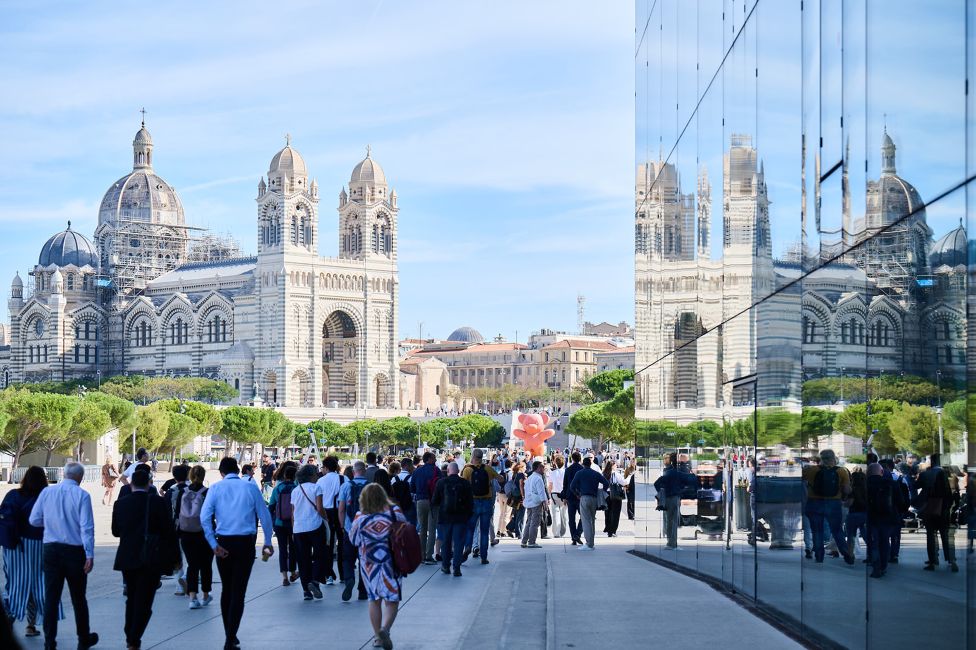
Marseille, France, 7th October 2026 — The European Partnership for Resilient Cultural Heritage (RCH), a major new initiative co-funded by the European Union, officially launched on 29 September 2026 in Marseille. The hybrid event, hosted by the Musée des civilisations de l’Europe et de la Méditerranée (MUCEM) and the Aix Marseille University (AMU), brought together more than 300 researchers, heritage professionals, policymakers and representatives of European and international organisations in person, with over 1,000 joining online.
As climate change threatens cultural heritage worldwide through extreme weather events and rising sea levels, the launch comes at a critical time. It marks the beginning of an ambitious ten-year initiative bringing together more than 90 partners from 30 countries in Europe and beyond to strengthen research and collaboration at the intersection of cultural heritage and climate change.
Glenn Micallef, European Commissioner for Intergenerational Fairness, Youth, Culture and Sport, welcomed the launch in a video message to attendees.
“It's clear that every aspect of our lives will be profoundly impacted by climate change and cultural heritage is no exception. Four years ago, a group of EU member state experts published a report entitled Strengthening Cultural Heritage Resilience for Climate Change, calling for research programs to boost knowledge sharing and cooperation between cultural heritage experts and climate science, and today we achieve an important milestone,” he said.
“With this very first partnership dedicated to culture, creativity, and inclusive society, under Cluster 2 of Horizon Europe, we will answer that call, we will launch a new era of collaborative, innovative research projects to enhance the preservation of Europe's cultural heritage.”
Isabelle Pallot-Frossard, President of France’s Fondation des sciences du patrimoine (FSP), which coordinates the Partnership, highlighted the significance of holding the event across Mucem and neighbouring Cosquer Méditerranée. The latter houses a replica of the nearby prehistoric Cosquer Cave, whose submerged entrance and partially flooded chambers illustrate the vulnerability of cultural heritage to changing sea levels.
“The official launch today, in this beautiful city of Marseille of the first European Partnership in the Social Sciences and Humanities, the Partnership for Resilient Cultural Heritage is a major event for the community of heritage science researchers and professionals in heritage conservation and promotion,” said Pallot-Frossard.
“As the president of FSP, I am therefore particularly proud to coordinate the Partnership on Resilient Cultural Heritage, with the support of the National Research Agency, and to actively contribute to the European heritage science ecosystem.”
Over the next decade, RCH will bring together research organisations and universities, public authorities, research funders, cultural heritage institutions, professional networks and civil society organisations to support interdisciplinary, transnational research.
The Partnership will fund research projects, build capacity and create new opportunities for collaboration. Its aim is both to help cultural heritage adapt to the growing impacts of climate change and to explore how heritage, the knowledge it carries, and the communities connected to it can contribute to more sustainable, resilient and just futures.
The Marseille launch placed key questions at the heart of the discussion: How can cultural heritage and climate science work together more effectively? How can researchers and practitioners collaborate across disciplines, sectors and national borders? And how can scientific evidence, alongside local and traditional knowledge, better inform policy and practice?
Stay tuned for the first RCH Joint Funding Call, expected to open later this year. Find out more about RCH and its activities here.
Um diese Website bestmöglich an Ihrem Bedarf auszurichten, nutzen wir Cookies und den Webanalysedienst Matomo, der uns zeigt, welche Seiten besonders oft besucht werden. Ihr Besuch wird von der Webanalyse derzeit nicht erfasst. Sie können uns aber helfen, indem Sie hier entscheiden, dass Ihr Besuch auf unseren Seiten anonymisiert mitgezählt werden darf. Die Webanalyse verbessert unsere Möglichkeiten, unseren Internetauftritt im Sinne unserer Nutzerinnen und Nutzer weiter zu optimieren. Es werden keine Daten an Dritte weitergegeben. Weitere Informationen hierzu finden Sie in unserer Datenschutzerklärung.