EHRI-DE: Permanent networking for Holocaust research
The European Holocaust Research Infrastructure (EHRI-ERIC) was established in 2025 as a permanent European research infrastructure to create an international network for research, documentation and education on the Holocaust. Germany is one of the ten founding members of the EHRI consortium.
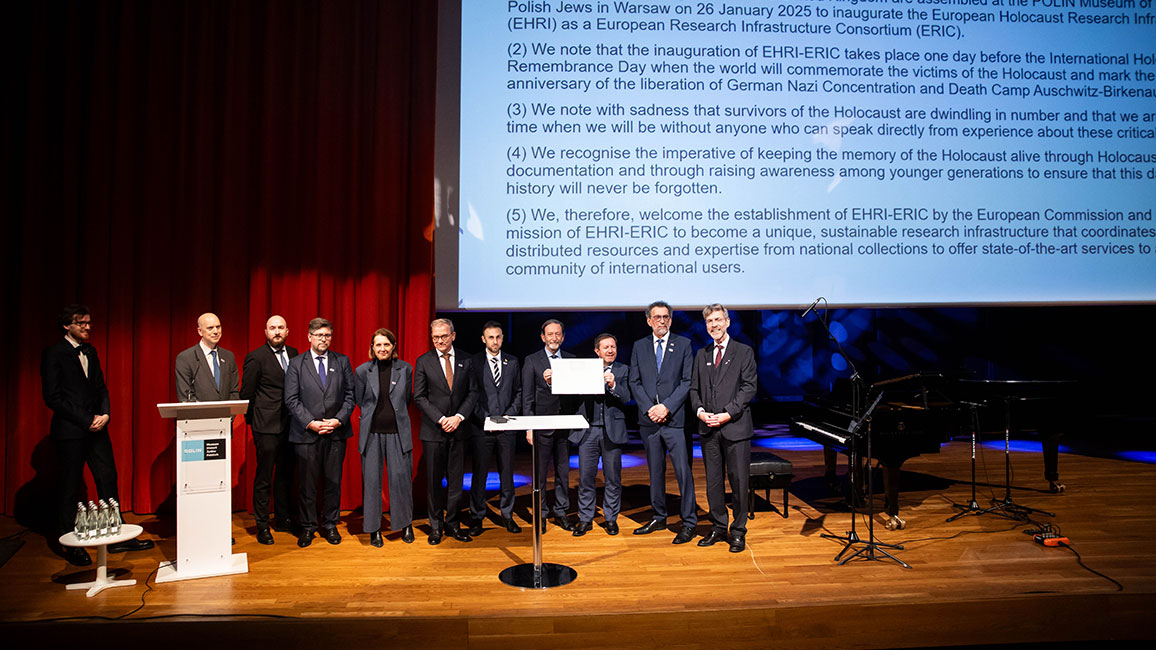
AEHRI becomes EHRI-ERIC: On 26 January 2025 – the eve of Holocaust Remembrance Day – a ceremony was held at the POLIN Museum in Warsaw to mark the occasion, during which a joint declaration by the member states was signed.
POLIN-Museum
Since February 2026, the coordination of the German EHRI node (EHRI-DE) at the Centre for Holocaust Studies at the Institute of Contemporary History in Munich has been funded by the BMFTR. The aim is to digitally consolidate and make accessible archival collections and research data, to strengthen international cooperation, and to ensure the long-term institutional sustainability of research.
Eight decades after the liberation of Auschwitz, the culture of remembrance is at a turning point. Personal testimonies are becoming increasingly rare. At the same time, misinformation, attempts to relativise the Holocaust and anti-Semitic narratives are spreading in the digital sphere. In this context, reliable, academically researched sources are of central importance. They make it possible to document historical events in a verifiable manner, to critically examine narratives and to ensure transparency in research. This is precisely where EHRI-ERIC comes in: the European research infrastructure brings together sources on the Holocaust scattered across the globe, connects archives and research institutions, and thus creates a lasting framework for international cooperation.
EHRI-ERIC – European Holocaust Research
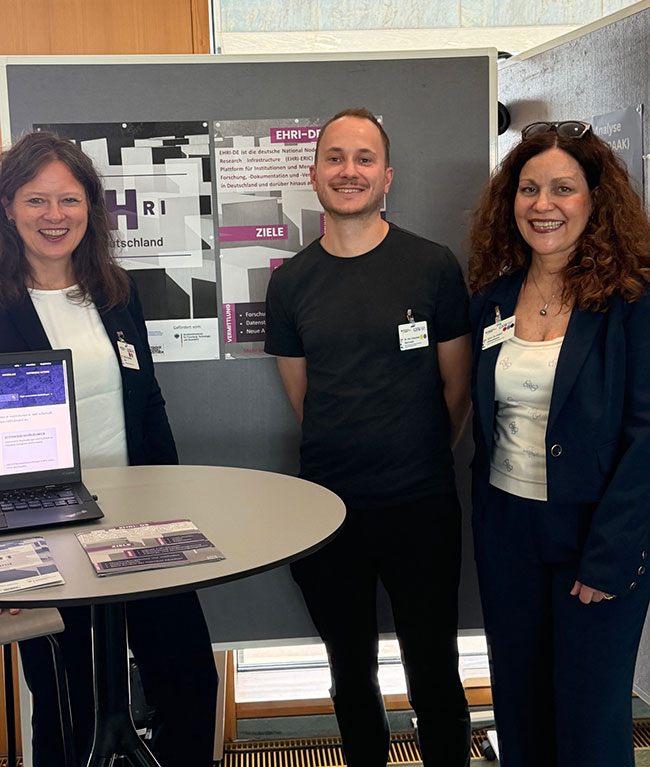
At the BMFTR in May 2026: Prof. Dr Andrea Löw, Academic Director of the Centre for Holocaust Studies, IfZ Munich, Dr des. Johannes Meerwald, Research Project Coordinator of the European Holocaust Research Infrastructure in Germany (EHRI-DE), and Prof. Dr Isabel Heinemann, Director of the Institute for Contemporary History Munich–Berlin.
Isabel Heinemann
In January 2025, the European Holocaust Research Infrastructure was officially established by the European Commission as a European research infrastructure consortium, known as an ERIC (European Research Infrastructure Consortium). This provided the consortium with a permanent legal and organisational basis after more than a decade of project-based collaboration (see GSW article). Germany is one of the founding members of EHRI-ERIC and also one of its largest funding bodies.
EHRI-ERIC is committed to digital accessibility and international networking. The consortium develops online services, databases and outreach formats that bring together archive holdings, expertise, metadata and research findings scattered across the globe. This enables historians to research, compare and contextualise sources across Europe – far beyond national borders. In doing so, the research infrastructure makes an important contribution to combating Holocaust denial and anti-Semitism, whilst strengthening Holocaust research, education and remembrance work.
At its heart is the EHRI portal: this online portal provides access to archival collections relating to the Holocaust, which are held in institutions scattered across the globe, both within and outside Europe. Researchers will find a wealth of resources there: country reports, an archive directory and digital editions of historical sources, a central research platform that brings together catalogue descriptions from numerous archives. In addition, there are digital editions, geo-based repositories and an academic blog that contextualises and interprets individual documents. This creates a virtual research space that complements, but does not replace, physical archives. EHRI-ERIC also sees itself as a research network that connects experts, specialist knowledge and new research approaches across national borders. Through programmes such as the Conny Kristel Fellowship, EHRI-ERIC promotes international mobility, thereby helping to establish cross-border collaborations and deepen methodological expertise in international Holocaust research.
EHRI-DE launches in Munich
On 1 February 2026, a new chapter in Holocaust research began in Germany: the Institute for Contemporary History (IfZ) in Munich received notification of funding for EHRI-DE, the German node of the EHRI network. Funded by the Federal Ministry of Research, Technology and Space (BMFTR), EHRI-DE is being established at the Centre for Holocaust Studies (ZfHS) there, in close cooperation with several partner institutions.
“EHRI-DE provides reliable information and sources on the Holocaust, the importance of which cannot be overstated given the increasing number of fake images and sources circulating. Furthermore, EHRI-DE is building networks both at home and abroad, bringing together researchers and institutions. At a time when a shift to the right is evident in many parts of the world, and the history of National Socialism and the Holocaust is being trivialised – including in Germany – the sources, historical knowledge and networks created here are of immense social significance,” says Andrea Löw, Director of the Centre for Holocaust Studies and the EHRI-DE project.
The IfZ in Munich has been part of the EHRI network since 2010 and, particularly through its Centre for Holocaust Studies, has played a key role in shaping the project’s previous phases: During the EHRI-3 phase, the IfZ coordinated, amongst other things, international training programmes, integrated Holocaust-related holdings from German archives into the portal and curated digital editions.
With EHRI-DE, the IfZ is now taking on a key role: “Through EHRI-DE, we are stepping up our efforts to foster sustainable collaborations, strategic development and expansion, and the long-term preservation of digital resources. The aim is to permanently pool existing expertise, integrate the German research landscape even more closely into the European network, and launch innovative projects in Germany and beyond,” explains Johannes Meerwald, National Coordinator of EHRI-DE.
Forward-looking plans
EHRI-DE will play an active role in further developing the content of the EHRI portal, which links Holocaust-related catalogue records scattered across the globe. The transnational Conny Kristel Fellowship Programme will also continue. In addition, the network of participating institutions in Germany (currently six institutions) is to be further expanded. A new portal is being launched: EHRI-DE will process existing metadata on victims of Nazi persecution in Germany from various sources, link them together and make them accessible via federated searches. “By providing this centralised access to standardised personal data, EHRI-DE offers a shared platform and database for research, as well as for remembrance and educational institutions and the interested public,” emphasises Meerwald. “Furthermore, we have set ourselves the goal of sustainably strengthening the teaching of the history of the Holocaust in Germany through workshops and seminars.”
Memory in the Digital Age
With the establishment of EHRI-ERIC and the development of EHRI-DE, a permanent European knowledge network is taking shape: it brings together research, documentation and public engagement. It also creates space for new questions and perspectives in Holocaust research. By linking archives, making sources digitally accessible and bringing together researchers across Europe, knowledge about the Holocaust is not only preserved – it remains permanently accessible, verifiable and open to further research.
EHRI-ERIC at a glance
Ten founding members: Germany, Israel, Croatia, the Netherlands, Poland, Austria, Romania, Slovakia, the Czech Republic and the United Kingdom.
The EHRI-ERIC Central Hub is based in the Netherlands (NIOD Institute for War, Holocaust and Genocide Studies at the Royal Netherlands Academy of Arts and Sciences in Amsterdam).
Other German partner institutions include the Federal Archives, the Arolsen Archives, the GWZO, the Fritz Bauer Institute and the German Exile Archive.
Key EHRI-ERIC services
The EHRI Portal provides access to information on archival material relating to the Holocaust held by institutions both within and outside Europe.
The EHRI online courses provide source material and background information, and offer an overview of current trends in Holocaust historiography across five thematic modules.
The EHRI Document Blog offers the opportunity to analyse working hypotheses, (preliminary) research findings and interesting source discoveries using digital tools, and to present them to a wider audience.
The EHRI seminars are aimed in particular at PhD students and early-career postdocs. These events, which usually last one week, offer an overview of methodological developments in the field of Holocaust studies, opportunities for discussion with experts, chances to present one’s own project, and an insight into the culture of remembrance in the region where the seminar is held.
The Institute for Contemporary History Munich–Berlin (IfZ)
The IfZ is an independent, non-university research institution which studies the entire history of Germany from the 20th century to the present day within its European and global contexts. It is a member of the Leibniz Association and receives institutional funding from the federal and state governments; in addition, the IfZ itself secures third-party funding for a wide range of research projects on contemporary history. The Centre for Holocaust Studies (ZfHS), which has been part of the IfZ since 2013, is an international centre of expertise and communication for research into the Holocaust. It organises conferences and workshops, carries out its own research and editorial projects, and, through its staff, contributes to university-level teaching on the Holocaust.
We want this website to meet your needs as best as possible. To this end, we use cookies and the web analytics tool Matomo to learn which pages are visited most often. Your visit is currently not being counted. By allowing us to count your visit anonymously, you help us to achieve this goal. Web analytics enable us to adapt this website to your needs. No data is forwarded to third parties. For further information, please see our privacy notice.