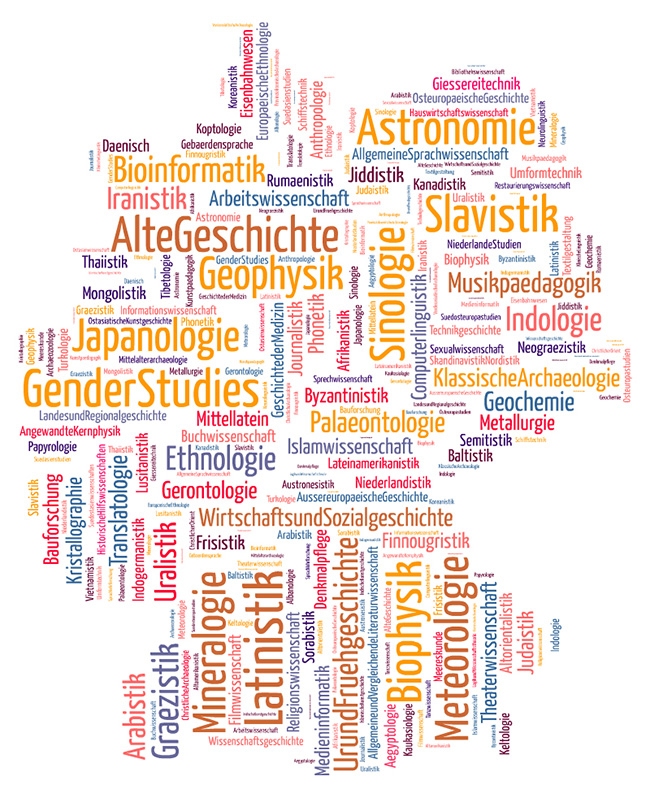
“Small Disciplines – Strong Together”: How transfer projects create a lasting impact
From the history of Jewish-Arab interconnections to the interpretation of sacred texts and new approaches in Chinese and Eastern European studies – during the four-year BMFTR funding period, the ‘minor subjects’ have carried out outstanding research on a wide range of topics. Now the focus shifts to the one-year transfer phase. Here is an initial insight.
BMFTR
Less commonly taught subjects contribute both to addressing societal challenges and to the study of cultural heritage. To strengthen these subjects at their respective universities and to network them across regions, the BMFTR has been funding them since 2017 under the funding schemes ‘Less Common Subjects – Great Potential’ (Federal Gazette of 24 June 2016) and ‘Minor Subjects – Strong Together’ (Federal Gazette of 2 September 2019). The selected collaborative projects under the 2019 funding scheme had the opportunity, following their four-year research phase, to apply as individual projects for a one-year transfer phase to carry out activities that contribute to the structural strengthening of the respective minor subject.
In the first call for proposals, two consortia received funding for the individual transfer projects: UrbanMetaMapping (video) and ReDiCo; both have already successfully completed their transfer phase. In the second and final round of calls for proposals, four BMFTR projects began their transfer phase in spring 2026. You can find out what these outstanding researchers aim to achieve here, and in the first-hand statements below directly from the project leaders.
Teaching the history of Jewish-Arab interdependence
The history of Jewish-Arab relations is not limited to narratives of conflict or coexistence, but requires a multifaceted, diachronic and methodologically complex perspective. This is the fundamental conviction underpinning the transfer project ‘Interconnection, Mediation, Networking: The History of Jewish-Arab Interconnection in Social Application and Institutional Networking’. It has been running since February 2026 at the Research Centre for Jewish-Arab Cultures at LMU Munich, led by Dr Theresa Bernheimer, and is based on the successfully completed BMFTR project ‘Beyond Conflict and Coexistence. A History of Interconnectedness in Jewish-Arab Relations’ (2022–2026).
The transfer project aims to structurally strengthen the ‘small disciplines’ of Jewish Studies and Islamic Studies/Middle Eastern Studies in two respects: Within the ‘Teaching Interconnectedness’ transfer strand, a modular online course is being developed which presents the history of Jewish-Arab interconnections in a didactically structured manner, enabling it to be applied in an interdisciplinary way and adapted to different educational contexts. In this way, the knowledge generated by the ‘small disciplines’ funding can be channelled into educational processes in schools, universities and civil society. In the second transfer strand, ‘Networking Interconnections’, an interdisciplinary network is being established with the aim of ensuring the long-term institutional anchoring and visibility within research policy of the history of Jewish-Arab interconnections. It is intended to bring together researchers from the fields of Jewish Studies, Islamic Studies, Middle Eastern Studies and related disciplines, both nationally and internationally.
Exploring the production and handling of sacred texts together
Imparting knowledge and bringing together researchers from different disciplines is also the aim of the HaZen (Manuscript Centre) transfer project at the Free University of Berlin. The basic idea is that, through collaborative work on the production and handling of sacred texts, the strengths of ‘small disciplines’ can be brought together and fully realised. After all, a shared perspective on the social, economic and religious interconnections between cultures not only fosters academic discourse and mutual understanding, but also makes a significant contribution to new insights into a central, identity-forming aspect of all literate cultures.
At the heart of HaZen lies the planning and establishment of a fellowship programme and a centre for research into the production and handling of sacred texts. The transfer project is led by Dr Annett Martini, formerly project leader of the BMFTR collaborative project ‘Materialised Holiness: Torah scrolls as a codicological, theological and sociological phenomenon of Jewish scriptural culture in the Diaspora’. The HaZen project will enable an important aspect not only of Jewish cultural history but also of European and non-European cultural history to be explored and made accessible to the wider public, for example through a knowledge repository, conferences, workshops, seminars and exhibitions. Furthermore, such a centre helps to raise the profile of ‘small disciplines’, attract students and early-career researchers, and thereby strengthen the fields of history and cultural studies as a whole.
Expanding research on Taiwan in a sustainable manner
Strengthening and networking Taiwan studies within the small subject area of Sinology – this has been the aim of the transfer project “Taiwan as a Pioneer – Dynamics arising from local innovation and global megatrends” (TAP Transfer) at the University of Trier since February 2026. It builds on the BMFTR consortium project ‘Taiwan as a Pioneer’ and is led by Dr Josie-Marie Perkuhn. During the transfer phase, it is raising the profile of the consortium’s main phase findings nationwide, expanding the established research network on an interdisciplinary basis, and opening it up to societal stakeholders beyond the academic world. At the same time, the collected research data will be transferred to a user-friendly publication platform, and the handbook on Taiwan studies produced by the consortium, “Taiwan Studies Reconfigured – Islands of Inquiry”, will be presented to a wider audience. In addition, plans are in place to establish a portal for Taiwan studies within the University of Trier’s digital infrastructure: two publication platforms – the ‘TAPHub’ database and the ‘Research College for Taiwan Studies’ digital forum – are intended to provide data, results and facilitate academic exchange. TAP Transfer already has programmes in place to support early-career researchers.
Reorienting Eastern European Studies and Ukrainian Studies
This transfer project, based at Justus Liebig University Giessen (JLU), aims to establish and sustain the supra-regional and interdisciplinary research network ‘War and Peace in Post-Socialist Space’ (WARP). Led by Dr Oleksandr Chertenko, the transfer project was launched in April 2026 and builds on the BMFTR collaborative project ‘(Un)Disciplined – Pluralising Ukrainian Studies, Understanding the War in Ukraine’ (UNDIPUS). The aim is to involve researchers from various social sciences and humanities disciplines who possess expertise on wars and violent conflicts in the post-socialist space in joint research and training projects. Furthermore, the research findings are to be presented in formats that reach a wider audience, thereby making them accessible to people outside the academic discipline.
The research network is linked to two JLU bodies: the Giessen Centre for Eastern Europe (GiZo) and the International Graduate Centre for the Study of Culture (GCSC)/Research Centre for the Study of Culture (RCSC). At the same time, the network is expanding interdisciplinary collaboration both across Germany and internationally. The research combines topical relevance with fundamental research. WARP aims to stimulate a shift in thinking and to establish Eastern European Studies and Ukrainian Studies as ‘laboratories’ that offer approaches and solutions to complex global challenges and transregional conflicts.
BMFTR funding for Small Disciplines
In order to strengthen the ‘small disciplines’ at their university locations and beyond, the support of early-career researchers and institutional and interdisciplinary networking are of central importance. Through two funding guidelines, the BMFTR supports since 2017 excellent research and networking in the ‘small disciplines’:
1. Funding Programme I ‘Small Disciplines – Great Potential’ (2017–22)
Funding for 9 collaborative projects and subsequent funding for 6 transfer projects.
We need your consent!
We want this website to meet your needs as best as possible. To this end, we use cookies and the web analytics tool Matomo to learn which pages are visited most often. Your visit is currently not being counted. By allowing us to count your visit anonymously, you help us to achieve this goal. Web analytics enable us to adapt this website to your needs. No data is forwarded to third parties. For further information, please see our privacy notice.